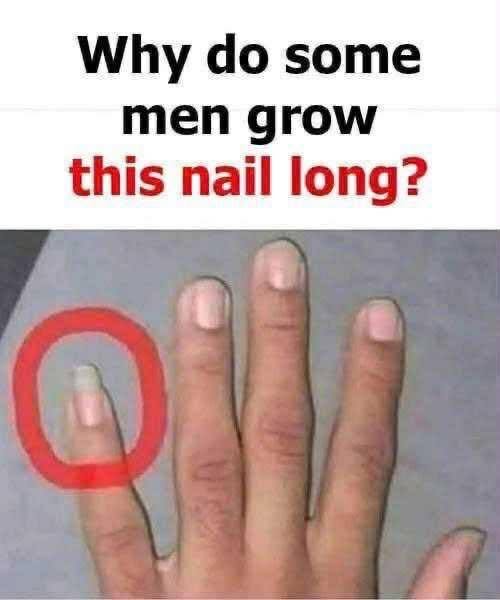
Why Do Some Men Keep Their Pinky Fingernail Long?
The Hidden Meaning Behind a Tiny Tradition
At first glance, it might seem like an odd grooming choice. Among otherwise neatly trimmed nails, one stands out—the pinky fingernail, noticeably longer than the rest. For some, it’s a quirky style. For others, it’s a quiet nod to tradition, identity, or even status. But why do some men keep their pinky fingernail long?
The answer isn’t simple. This small detail carries centuries of cultural symbolism, practical uses, social signals, and modern reinterpretations. What may appear insignificant can actually reflect history, personal expression, or even professional identity.
Let’s explore the hidden meanings behind this tiny yet intriguing tradition.
A Symbol of Status and Refinement
One of the earliest known reasons for a long pinky nail dates back to ancient China. During imperial times, scholars and members of the upper class would grow their pinky fingernails long to signal that they did not engage in manual labor. Long nails demonstrated that a person’s hands were not used for physical work—an unmistakable symbol of privilege and education.
In this context, the pinky nail became a subtle badge of refinement. It communicated intellectual status, wealth, and leisure without a single word spoken.
Similarly, in some parts of South Asia and Southeast Asia, longer nails historically signified that someone was part of the educated or elite class. It was a quiet way of saying, “I work with my mind, not my hands.”
Practical Origins in Everyday Life
Beyond symbolism, practicality has also played a role.
Before the widespread use of modern tools and accessories, a longer pinky nail served as a convenient multipurpose tool. It could be used to:
-
Open letters
-
Untie small knots
-
Pick at tiny objects
-
Separate thin papers or fabrics
In trades such as tailoring or textile work, a slightly longer nail could assist with delicate tasks. Musicians, especially string players, have sometimes grown specific nails for technique-related reasons, though this is more common on the dominant hand rather than exclusively the pinky.
In certain professions, the long pinky nail was simply a handy, built-in tool—small but useful.
A Sign of Cultural Identity
In various cultures, grooming choices often carry deeper meaning. The pinky nail tradition has appeared in different regions as a subtle sign of belonging.
In some Latin American communities during the 20th century, a long pinky nail could signal that someone was stylish or fashion-conscious. In parts of Europe and Asia, it occasionally became associated with artistic or bohemian identity—writers, poets, or intellectuals adopting it as a small, unconventional flourish.
Like hairstyles or jewelry, the pinky nail sometimes functions as a quiet marker of individuality within a broader social group.
Modern Interpretations and Controversy
In more recent decades, the long pinky fingernail has taken on additional interpretations—some positive, others more controversial.
In certain circles, it became associated with nightlife culture and specific subcultures. This association has led to mixed perceptions. While some view it as stylish or expressive, others may attach stereotypes to it.
Importantly, meanings vary greatly depending on region and context. In one country, it may signal fashion or tradition; in another, it may carry entirely different assumptions.
Because of these varied interpretations, some men who keep their pinky nail long today do so purely out of personal habit or aesthetic preference, without any deeper symbolism at all.
A Subtle Expression of Individuality
In a world where fashion trends change rapidly, small personal choices often become ways to stand out. Growing one nail longer than the rest is subtle but noticeable. It can feel like a quiet rebellion against uniform grooming standards.
For some men, it’s simply tradition passed down from a father or grandfather. For others, it may be a conversation starter—an unusual detail that sparks curiosity.
Unlike tattoos or bold hairstyles, a long pinky nail is discreet. It doesn’t dominate one’s appearance but still adds a distinctive touch.
Psychological and Social Signals
Human beings constantly interpret visual cues, even small ones. A long pinky nail can unconsciously send signals:
-
Nonconformity
-
Cultural awareness
-
Attention to detail
-
A connection to tradition
At the same time, because grooming norms differ by culture, reactions can vary widely. In some settings, it may go unnoticed. In others, it may prompt curiosity or questions.
This demonstrates how even the smallest grooming choice can influence perception.
Is It Still Relevant Today?
In today’s globalized world, traditions often lose their original meaning while gaining new ones. The pinky fingernail tradition is no exception.
For some, it remains a cultural practice tied to heritage. For others, it has become a fashion statement or nostalgic nod to earlier decades. And for many, it may simply be habit—something they’ve always done without much thought.
Interestingly, trends often cycle back. As vintage and retro aesthetics resurface in fashion, small details like this occasionally reappear in style conversations.
What Does It Really Mean?
The truth is, there’s no single universal meaning behind a long pinky fingernail.
It could represent:
-
Historical status and scholarship
-
Practical functionality
-
Cultural identity
-
Artistic individuality
-
Fashion preference
-
Personal habit
Context matters. Geography matters. Personal intention matters most of all.
Before making assumptions, it’s worth remembering that traditions evolve. What once symbolized elite intellectual status may now simply be a personal quirk.
Final Thoughts
The long pinky fingernail may seem like a tiny detail, but it carries a surprisingly rich history. From imperial scholars signaling their social standing to modern individuals expressing subtle uniqueness, this small grooming choice has traveled through centuries and across cultures.
Ultimately, its meaning depends on the person wearing it. It might be tradition, symbolism, practicality, or nothing more than preference.
In a world where identity is often communicated through the smallest details, even a single fingernail can tell a story—if you take the time to look closer.