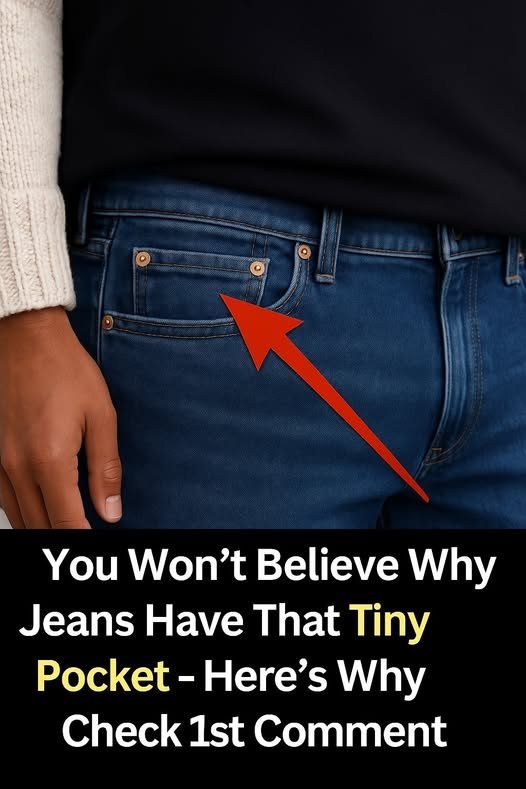
The Story Behind the Tiny Pocket on Your Jeans
If you have ever worn a pair of jeans, you have probably noticed the small pocket tucked inside the larger front pocket. It’s tiny, narrow, and often seems too small to hold anything useful. Many people wonder why it exists at all. Is it just a design feature, or does it have a real purpose?
Surprisingly, that tiny pocket has a fascinating history that goes back more than 150 years. What may seem like a decorative detail today actually began as a practical feature designed for a specific item that people relied on in everyday life.
Understanding the story behind the tiny pocket reveals how fashion often reflects the needs and lifestyles of different historical periods.
The Birth of Blue Jeans
To understand the purpose of the small pocket, we first need to look at the origins of jeans themselves.
Jeans were first created in the 19th century during the American Gold Rush. At that time, miners, laborers, and cowboys needed clothing that could withstand extremely tough working conditions. Ordinary trousers wore out quickly, especially when workers carried tools or spent long days outdoors.
In 1873, a tailor named Jacob Davis partnered with businessman Levi Strauss to create durable work pants reinforced with metal rivets. These pants became the first official blue jeans.
Their company, Levi Strauss & Co., began producing sturdy denim trousers designed specifically for working men. These jeans quickly became popular because they were strong, comfortable, and long-lasting.
The Original Purpose of the Tiny Pocket
The small pocket we see today was originally created to hold a pocket watch.
In the late 1800s, wristwatches did not yet exist. Most people carried small watches attached to a chain, known as pocket watches. These watches were valuable and somewhat delicate, so they needed to be stored safely.
The tiny pocket inside the front pocket of jeans provided the perfect solution. It allowed workers to keep their watch secure and separate from coins, tools, or other items that might scratch or damage it.
Because of this purpose, the small pocket was originally called a watch pocket.
Early advertisements and catalogs from Levi Strauss & Co. even referred to it specifically as a pocket designed for watches.
Why Workers Needed It
For miners, ranchers, and railroad workers, keeping track of time was important. Work schedules, train timetables, and daily routines often depended on accurate timekeeping.
Pocket watches were reliable, but they needed protection. The watch pocket allowed workers to store their timepiece in a snug space where it wouldn’t move around or break during physical labor.
The design was simple but extremely practical.
How the Pocket Survived Over Time
As fashion evolved, wristwatches gradually replaced pocket watches during the early 20th century. Despite this shift, the tiny pocket remained part of the classic jeans design.
There are a few reasons why it never disappeared.
First, it had become a recognizable element of jeans. People were used to seeing it, and it became part of the traditional style.
Second, manufacturers often preserve iconic design features because they connect modern clothing to its historical roots.
Even though its original purpose became less common, the watch pocket continued to appear on nearly every pair of jeans produced around the world.
Modern Uses for the Tiny Pocket
Today, the small pocket has found many new uses. Even though it was originally meant for pocket watches, people now use it to carry a variety of small items.
Common modern uses include:
-
Coins
-
Guitar picks
-
Rings or small jewelry
-
USB drives
-
Lighters
-
Keys
Some people even use it as a convenient place to store a small emergency item, like a folded note or spare memory card.
Its size and location make it surprisingly practical for tiny objects that might otherwise get lost in a larger pocket.
Different Names for the Pocket
Over time, the small pocket has gained several informal names.
You might hear it referred to as:
-
Watch pocket
-
Coin pocket
-
Ticket pocket
-
Match pocket
Although these names vary, the original historical name remains watch pocket, reflecting its first intended purpose.
A Small Detail with Big History
The tiny pocket on jeans may seem like a minor design element, but it represents an interesting piece of clothing history. It shows how garments evolve alongside technology and everyday life.
In the 19th century, it solved a practical problem by protecting pocket watches. In the modern world, it has become both a functional feature and a symbol of traditional denim design.
Many people wear jeans every day without realizing that this little pocket carries a story that dates back more than a century.
Why Classic Designs Endure
Fashion trends change constantly, but certain design elements remain because they are tied to history and identity. Jeans themselves are a perfect example.
What started as rugged workwear for miners eventually became one of the most popular clothing items in the world. Today, jeans are worn by people of all ages and backgrounds, from casual wear to high fashion.
Small details like the watch pocket help preserve that original heritage.
Final Thoughts
The next time you put on a pair of jeans, take a moment to notice that tiny pocket. What looks like a simple decorative feature actually has a long and practical history.
Originally created to hold pocket watches during the 1800s, the watch pocket reflects the needs of workers from a different era. Even though technology has changed, this small piece of design has remained part of the classic jeans structure.