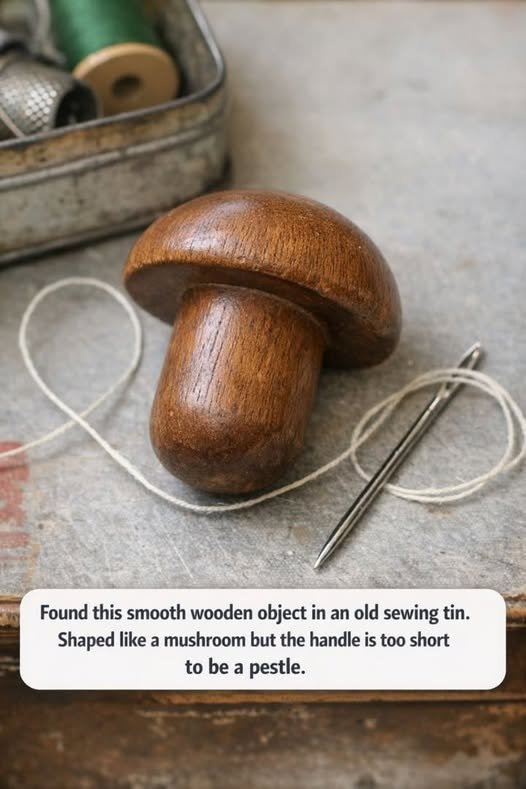
Found This Smooth Wooden Object in an Old Sewing Tin – What Is It?
Discovering an unfamiliar object tucked away in an old sewing tin can feel like uncovering a small mystery from the past. Many people who sort through vintage sewing kits or inherited craft boxes occasionally find unusual tools that no longer appear in modern sewing sets. One such object that often puzzles people is a smooth wooden tool shaped somewhat like a mushroom, with a rounded top and a short handle. At first glance, it might look like a miniature pestle, a toy, or even a decorative piece. However, in many cases, this intriguing item turns out to be a traditional sewing aid known as a darning mushroom.
The Mystery of the Mushroom-Shaped Tool
If you found a wooden object with a dome-shaped top and a short handle in an old sewing tin, there is a good chance it was used for repairing clothing rather than cooking or decoration. These tools were commonly included in sewing kits during the late 19th and early 20th centuries, when repairing garments was a regular household skill. Before fast fashion and inexpensive clothing became widely available, people took great care to maintain and mend their clothes to extend their lifespan.
A darning mushroom is specifically designed to help repair holes in fabric, especially in socks, sweaters, and other knitted garments. Its shape may seem unusual at first, but it serves a very practical purpose when performing the sewing technique known as darning.
What Is Darning?
Darning is a traditional sewing method used to repair holes, tears, or worn areas in fabric by weaving thread across the damaged section. Instead of simply patching a hole with another piece of fabric, darning recreates the structure of the original material by interlacing threads in a grid-like pattern.
This technique was particularly important for repairing socks, which frequently developed holes in the heel or toe due to friction and repeated use. With the help of a darning mushroom, the repair could be done neatly and securely while maintaining the shape of the garment.
Why the Mushroom Shape?
The mushroom-like shape of the tool is not just aesthetic—it is carefully designed to make darning easier and more effective. The rounded dome acts as a small surface that fits inside the damaged area of a garment. For example, if you were repairing a hole in a sock, you would place the mushroom inside the sock so that the hole stretches over the smooth wooden top.
This provides several benefits:
- Stable surface: The dome keeps the fabric stretched and smooth while you sew.
- Better visibility: The hole becomes easier to see and work on.
- Even tension: The fabric remains taut, helping you create evenly spaced stitches.
- Protection for your fingers: The wooden surface prevents the needle from accidentally pricking your hand.
The short handle allows the user to hold the mushroom securely or rest it on a table while sewing.
A Common Tool in Vintage Sewing Kits
During the late 1800s and early 1900s, sewing tools were essential household items. Families often kept well-stocked sewing tins filled with needles, thread, buttons, thimbles, and various small tools for repairing clothing. A darning mushroom was frequently included because socks and knitwear required frequent repairs.
Some versions were made entirely of smooth wood, while others included a detachable handle or a hollow compartment inside the handle for storing needles or thread. Over time, these tools became less common as mass-produced clothing became cheaper and easier to replace.
Today, many people rediscover them in antique sewing kits, thrift stores, or family heirlooms.
How to Use a Darning Mushroom
Using a darning mushroom is surprisingly simple, even for beginners. Here is the basic process:
- Insert the mushroom into the garment.
Place the rounded top under the hole so that the damaged area stretches across the dome. - Secure the fabric.
Some people use a rubber band or elastic thread around the fabric to keep it firmly positioned on the mushroom. - Create anchor stitches.
Begin stitching across the hole with thread, forming parallel lines that extend slightly beyond the damaged area. - Weave the threads.
Next, weave the needle in and out of the existing stitches, creating a woven grid that fills the hole. - Finish and secure.
Tie off the thread and gently remove the mushroom from the garment.
The result is a reinforced patch that blends with the surrounding fabric and prevents the hole from expanding further.
A Tool Making a Comeback
Interestingly, tools like the darning mushroom are gaining renewed popularity today. With the growing interest in sustainable living, slow fashion, and textile repair, many people are rediscovering traditional sewing techniques.
Repairing clothing instead of throwing it away reduces textile waste and encourages a more thoughtful approach to fashion consumption. As a result, modern craft enthusiasts, knitters, and menders are once again turning to classic tools like the darning mushroom.
You can now find new versions in craft stores, online marketplaces, and specialty sewing shops. Some contemporary designs are even made from polished hardwoods or include ergonomic handles for easier use.
Could It Be Something Else?
While a mushroom-shaped wooden object found in a sewing tin is very likely a darning mushroom, it’s worth noting that similar shapes have occasionally been used for other small household tools. However, when such an object is discovered alongside sewing needles, thread, and buttons, the darning tool explanation is usually the most accurate.
Its smooth wooden surface, rounded dome, and compact handle are all characteristics specifically suited to fabric repair.
A Small Piece of Sewing History
Finding a mysterious tool in an old sewing kit offers a glimpse into the everyday lives of previous generations. Objects like the darning mushroom remind us that clothing was once carefully maintained and repaired rather than quickly replaced.
What might appear to be an odd wooden object is actually a practical and cleverly designed tool that helped families preserve their garments for years. If you happened to discover one in a vintage sewing tin, you are holding a small but meaningful piece of sewing history—one that continues to inspire modern makers and menders today.
So the next time you come across a smooth wooden tool shaped like a tiny mushroom, you will know that it likely played an important role in keeping socks, sweaters, and cherished garments wearable for much longer.