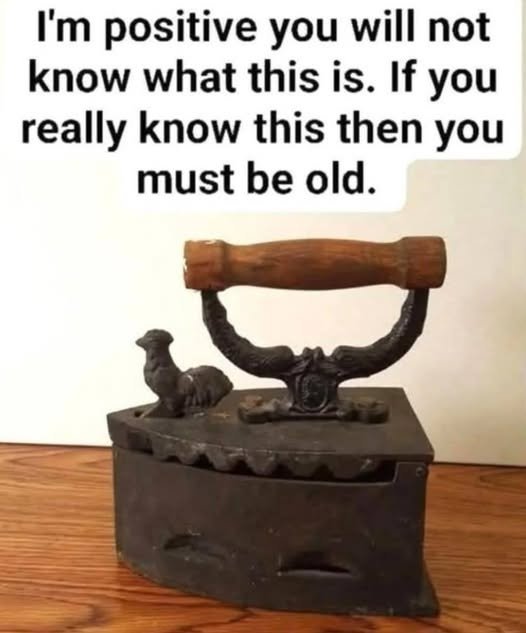
The Mystery Object in the Photo: A Charcoal Box Iron
In today’s world of sleek steam irons and high-tech appliances, it’s easy to forget the fascinating history behind everyday household tools. Occasionally, an old object surfaces—perhaps in a family attic, a flea market, or a vintage photo—and leaves people wondering about its purpose. One such intriguing item is the charcoal box iron, a relic from a time when innovation looked very different from what we know today.
At first glance, this mysterious object may appear bulky, metallic, and somewhat unusual in shape. With a hinged lid, ventilation holes, and sometimes even a small chimney-like feature, it hardly resembles the modern irons we use today. Yet, this antique tool once played a vital role in daily life, helping households keep their clothes neat and wrinkle-free.
What Is a Charcoal Box Iron?
A charcoal box iron is an early type of clothing iron that uses hot charcoal as its heat source. Before electricity became widely available, people relied on alternative methods to generate heat for pressing clothes. This iron was essentially a small metal box designed to hold burning charcoal inside.
The heat from the charcoal would warm the metal base of the iron, which could then be used to smooth wrinkles from fabric. Unlike traditional flat irons that needed to be heated externally on a stove, charcoal irons carried their own heat source, making them more efficient for longer use.
How Did It Work?
Using a charcoal box iron required a bit of preparation and care. First, small pieces of charcoal would be lit and allowed to burn until they produced steady heat. These glowing embers were then placed inside the iron’s compartment through the hinged lid.
The iron often featured ventilation holes on the sides to allow oxygen to feed the charcoal and maintain the heat. Some models even included a small chimney or vents to direct smoke away from the user. Once the charcoal was burning steadily, the iron would heat up quickly and remain hot for an extended period.
To use it, the person would simply glide the iron over clothing, much like we do today. However, managing the heat required skill—too much heat could scorch delicate fabrics, while too little would not remove wrinkles effectively.
A Glimpse Into Daily Life
The charcoal box iron offers a fascinating glimpse into the daily routines of people in the past. Laundry day was often a labor-intensive process that required time, patience, and physical effort. Heating irons, maintaining fire sources, and carefully pressing garments were all part of the routine.
Unlike today’s convenient appliances, these irons demanded constant attention. Users had to monitor the charcoal, shake the iron occasionally to keep embers burning evenly, and sometimes fan the coals to maintain heat. Despite these challenges, the charcoal iron was considered an advancement because it eliminated the need to repeatedly reheat a solid iron on a stove.
Why Was It Designed This Way?
The design of the charcoal box iron reflects both practicality and ingenuity. Before electricity became common in households, people had to rely on readily available resources—like wood and charcoal—to generate heat.
By enclosing the charcoal within the iron itself, designers created a portable heat source that could be used anywhere. The ventilation holes ensured proper airflow, while the sturdy metal construction retained heat efficiently. Some models even included wooden handles to prevent users from burning their hands.
This clever combination of materials and design made the charcoal iron a reliable and widely used tool in many parts of the world.
Where Were Charcoal Irons Used?
Charcoal box irons were used across various regions, particularly in parts of Asia, Africa, and Europe. In many countries, they remained in use well into the 20th century, even after electric irons became available elsewhere.
In rural areas or places without access to electricity, charcoal irons were often the preferred choice. Even today, they can still be found in some regions where modern appliances are not easily accessible.
Safety and Challenges
While effective, charcoal irons were not without their drawbacks. One of the main concerns was safety. The burning charcoal inside the iron could produce smoke and, in poorly ventilated spaces, pose health risks.
There was also the risk of burns or accidental fires if hot embers spilled out. Additionally, controlling the temperature required experience, as there were no thermostats or automatic shut-off features.
Despite these challenges, people adapted to using these tools safely through careful handling and experience.
From Everyday Tool to Collector’s Item
Today, the charcoal box iron is no longer a household necessity—it has become a fascinating collectible and a symbol of history. Antique enthusiasts and collectors often seek out these irons for their unique design and historical significance.
You might find them displayed in museums, used as decorative pieces, or preserved as part of cultural heritage collections. Each iron tells a story about the time and place it came from, offering insight into how people lived and worked in earlier eras.
Why It Still Captures Attention
The charcoal box iron continues to spark curiosity because it represents a blend of simplicity and ingenuity. For many people seeing it for the first time, its purpose isn’t immediately obvious, which adds to its mystery.
In a world dominated by modern technology, objects like this remind us of how far we’ve come—and how creative people were in solving everyday problems with limited resources.
Final Thoughts
The next time you come across a strange, antique-looking object with a hinged lid and metal body, you might just be looking at a charcoal box iron. What once was a practical household tool is now a window into the past, showcasing human innovation and resilience.
Understanding these historical items not only satisfies curiosity but also deepens our appreciation for the conveniences we often take for granted today. The charcoal box iron may be a mystery at first glance, but once you learn its story, it becomes a powerful reminder of the ingenuity of earlier generations.