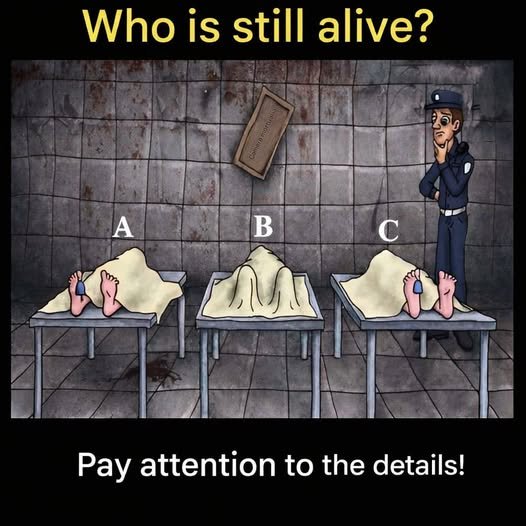
Riddle: Can You Guess Who Is Still Alive?
Riddles have a unique way of capturing our imagination. They make us pause, think, and sometimes challenge the way we interpret words. One riddle that has puzzled and intrigued many is deceptively simple:
“Can you guess who is still alive?”
At first glance, it seems straightforward, but as with many classic riddles, the solution often lies in thinking outside the box. In this article, we will explore this riddle, its possible meanings, and why it fascinates people of all ages.
The Power of a Simple Question
The beauty of the riddle lies in its simplicity. Three short words—“still alive”—force your brain to pause and consider the meaning. Are we talking about a specific person? A group of people? Or something metaphorical?
Riddles like this are not just brain teasers; they are a way to sharpen reasoning skills, develop lateral thinking, and even stimulate creativity. When a riddle asks “who is still alive?”, it forces the mind to question assumptions, consider alternative interpretations, and explore abstract ideas.
Literal Interpretation
The most straightforward way to approach this riddle is to take it literally. In this sense, the answer could be anyone or anything that exists and has not yet ceased to live.
-
People: Anyone currently breathing, reading the riddle, or present in a certain place could be considered “still alive.”
-
Animals: Pets, wildlife, or livestock fit the description as well.
-
Plants: Trees, flowers, and even microscopic life are technically alive.
In the literal sense, the riddle’s answer could simply be “you”. Anyone reading the riddle is alive at that moment, which makes the riddle interactive and self-reflective. It becomes less about a distant mystery and more about engaging the reader personally.
Metaphorical Interpretations
Riddles often rely on metaphor and symbolism. In this case, “still alive” can be interpreted beyond the biological sense:
-
Ideas and Concepts: Some riddlers argue that ideas, memories, and stories are “alive” as long as people remember them. For example, Shakespeare’s works are still alive because they continue to influence culture centuries later.
-
The Future: The concept of tomorrow or upcoming events is “alive” in potential. Nothing has ended; the possibilities still exist.
-
Feelings and Emotions: Love, hope, and curiosity are often described as being “alive” in the heart and mind, symbolizing vitality beyond physical life.
Thus, the riddle can serve as a philosophical prompt: it’s not just about biology; it’s about the persistence of life, thought, and existence in multiple forms.
Why This Riddle Works
Several elements make this riddle effective:
-
Brevity: Its short phrasing makes it easy to remember and share.
-
Ambiguity: Without context, it forces the mind to consider multiple interpretations.
-
Interactivity: People naturally ask themselves, “Am I alive?” or “Who else is alive?” when confronted with the question.
-
Curiosity Factor: The question taps into a universal curiosity about life, death, and existence.
Because of these qualities, it’s perfect for classrooms, social media posts, or casual conversations. It’s not just a riddle—it’s a conversation starter.
How People Typically Answer
Responses to this riddle vary widely depending on perspective:
-
Practical Thinkers: “Anyone breathing right now.”
-
Philosophical Thinkers: “Ideas, memories, and stories that endure are still alive.”
-
Humorous Thinkers: “My coffee this morning—it’s alive in my heart!”
-
Creative Thinkers: “Tomorrow is alive; yesterday is gone.”
The variety of answers is part of the charm. No single answer is entirely wrong, as the riddle encourages exploration of thought rather than fixed conclusions.
Teaching and Learning Applications
This riddle is not just entertainment; it can also serve as a teaching tool:
-
Critical Thinking: Encourages students to analyze the meaning of words and context.
-
Philosophy: Sparks discussions about life, existence, and what it means to be “alive.”
-
Creative Writing: Inspires imaginative answers and storytelling.
-
Language Skills: Highlights the nuances of words like “still” and “alive,” showing how meaning can change based on interpretation.
Teachers and parents can use this riddle as an engaging activity to teach reasoning, perspective-taking, and even empathy by considering how others might interpret the same words differently.
A Fun Challenge for Friends
Riddles like this also make great icebreakers. Present the question in a social setting and watch how people react. Some will give literal answers, some will offer witty or philosophical responses, and others may pause entirely to think deeply. It’s a small yet effective way to spark lively discussion, laughter, and thought.
Final Thoughts
The riddle “Can you guess who is still alive?” is deceptively simple but deeply engaging. Its power comes from its ability to encourage reflection, interaction, and creativity.
Whether you interpret it literally, metaphorically, or philosophically, the riddle reminds us of one universal truth: life exists in many forms, and recognizing it—whether in ourselves, others, or the world around us—is part of the human experience.